

What are the fundamental laws governing the universe, from its most elementary components through to its largest structures? What are the properties of matter organised at the scale of nanoscience? These are just some of the questions that concern researchers in the fields of physical sciences and the universe. To answer these questions, the CEA is conducting cutting-edge fundamental research, and contributing to the development and use of numerous internationally-recognised research instruments such as the James Webb telescope and the LHC.
Our missions
Understanding the fundamental and theoretical laws of the Universe
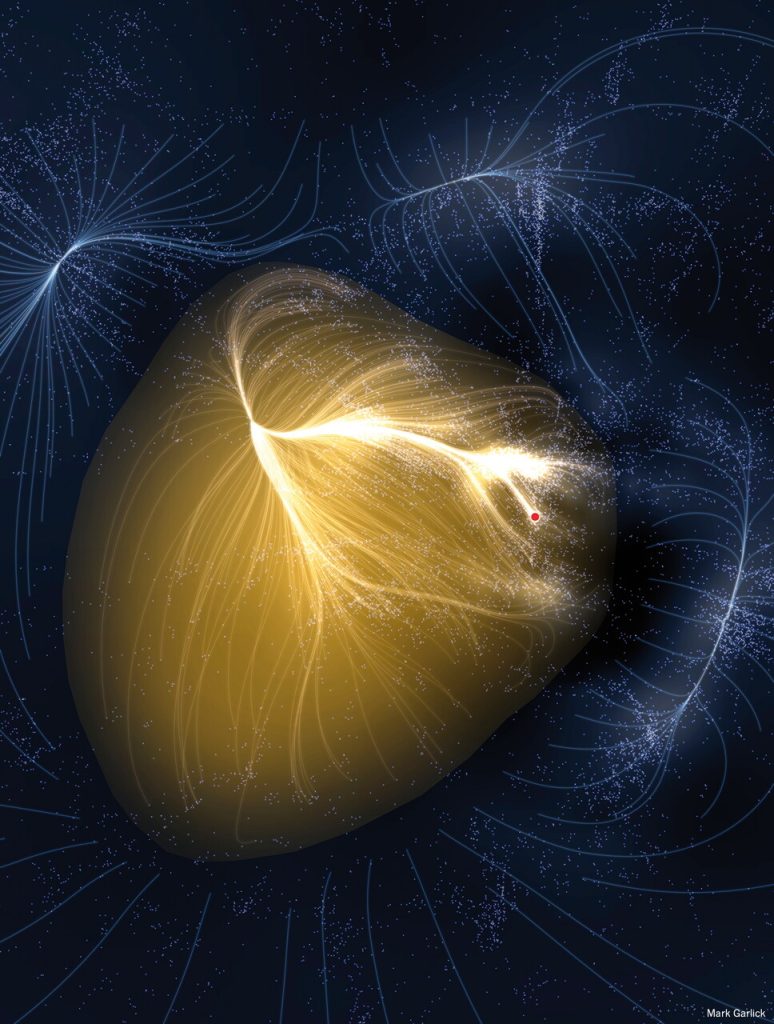
The CEA’s mission is to answer the main questions about the four fundamental interactions of the Universe through astrophysics, nuclear physics, particle physics, and related technological expertise.
CEA researchers devise or participate in the design of numerous large-scale experiments. They have thus developed expertise in particle accelerators and telescopes, as well as in radiation detection, information processing, cryotechnologies, and high-performance computing. The CEA is recognized for its expertise in superconducting cavities and magnets, cryogenerators, and detectors (micromegas, bolometers, etc.).
The CEA also studies the physical and mathematical laws that govern the Universe, its structure, and its organization. It conducts research in all major areas of modern theoretical physics: High energy physics, cosmology, quantum gravity, string theory, exact methods and mathematical physics, condensed matter physics and quantum physics, statistical physics and non-equilibrium systems, biological systems, complex systems and dynamical networks.
Studying new materials and states of matter
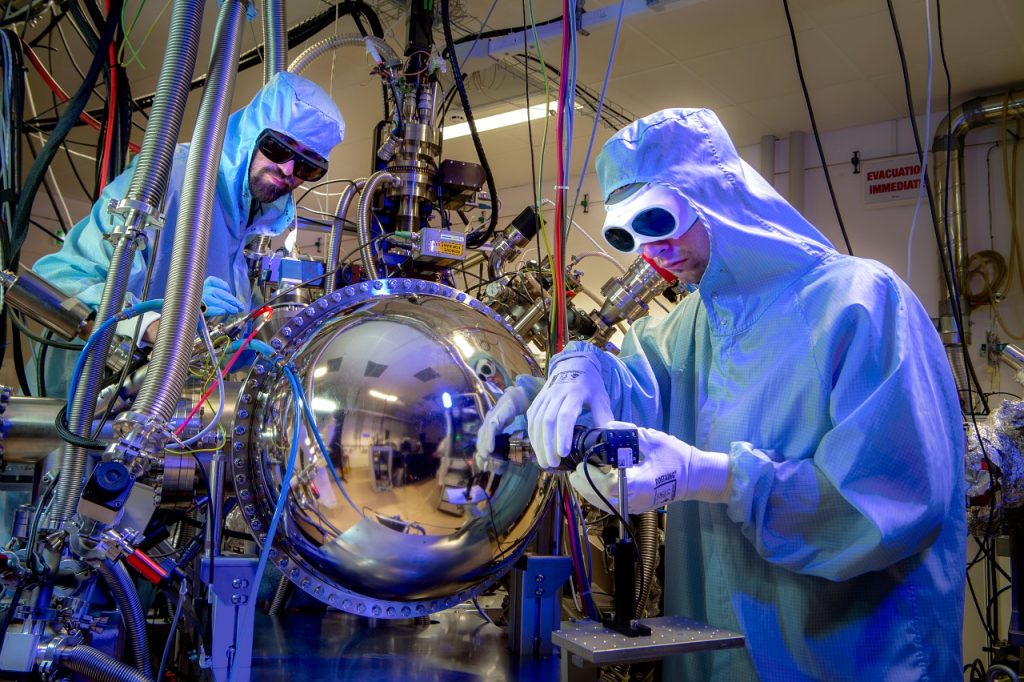
Mastering the states of matter and inventing new materials are key to observing novel phenomena, paving the way for applications ranging from new energy technologies to information technologies and nuclear energy. In this field, the CEA is developing a continuum of expertise from condensed and dilute matter physics to laser physics, while also developing capabilities in chemical synthesis and the characterization of nano-objects.
Harnessing fusion energy
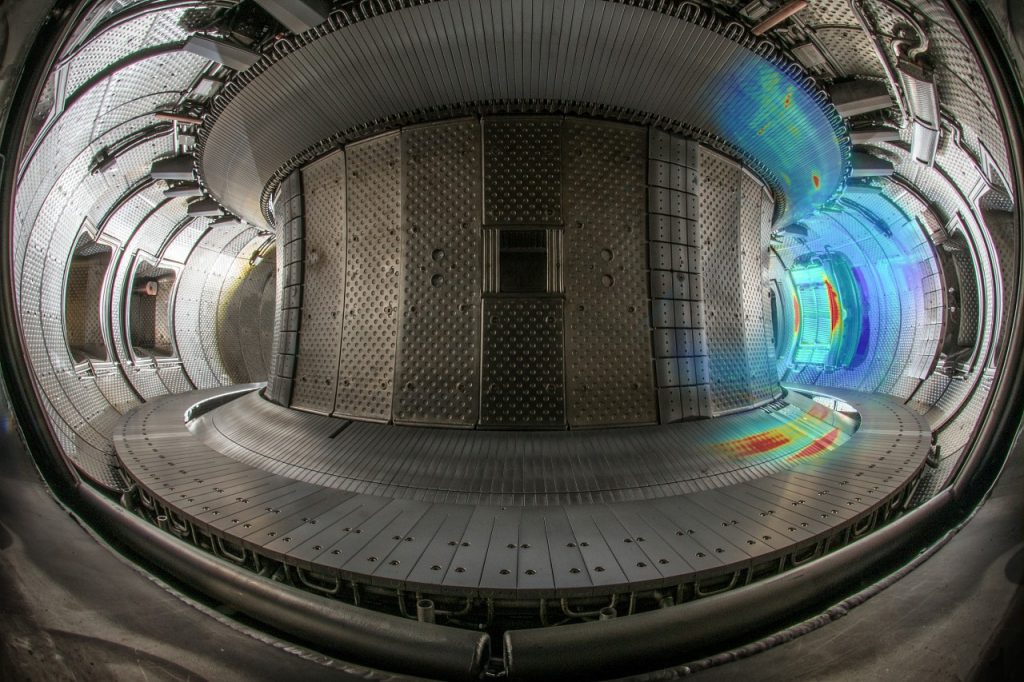
CEA researchers are looking for recreating on Earth the nuclear fusion that occurs in the heart of stars in order to have a virtually inexhaustible energy source. Experiments on its WEST tokamak, which holds the world record for plasma duration, are preparing the ground for the operation of the international ITER tokamak.
© : Mark A. Garlick / source: Daniel Pomarè / L. Godart / CEA – C. Roux/CEA