

When a nuclear facility is permanently shut down, it undergoes dismantling and decontamination. Dismantling involves taking apart the equipment; decontamination involves removing most of the residual radioactivity. The waste generated by these operations is packaged and sent to appropriate disposal facilities. As a nuclear operator, the CEA is responsible for dismantling its facilities and managing the resulting waste. It also plays a key role in research on the techniques and technologies used in dismantling operations.
Some key figures
36
facilities to be dismantled by the CEA
€740 million
allocated annually to the dismantling of CEA facilities and the reprocessing of legacy waste
5 CEA civilian sites concerned
Fontenay-aux-Roses, Saclay, Marcoule, Cadarache te Grenoble
100+
decontamination and dismantling projects
At the CEA, each dismantling site is unique
As both a nuclear operator and an R&D provider, the CEA’s distinctive characteristic lies in the wide variety of facilities it operates and, therefore, the variety of facilities that will eventually need to be dismantled. Reactors (of different technologies), accelerators or irradiators, high-activity laboratories, fuel cycle facilities, and waste treatment or storage facilities… The dismantling of each of these facilities is a unique case.
This represents a genuine technical challenge, which gives the CEA significant experience in dismantling, both in project management and in methodologies and expertise required for their execution.
A particular difficulty in dismantling at the CEA is based on the fact that the sites are former research facilities, which have undergone numerous modifications over the years and have used radioactive materials of various types, resulting in potentially high levels of radioactivity.
CEA’s Project Prioritization Strategy
The simultaneous shutdown of a significant number of facilities, due to their technical obsolescence, new safety standards, and the evolution of its research programs, all within a constrained budgetary context, led the CEA to prioritize its dismantling projects. This project prioritization strategy was established in 2015 at the request of the safety authorities (ASNR and ASND) and in collaboration with them.
The primary criterion for this prioritization is the “mobilizable source term,” meaning the assessment of risks associated with the facility in terms of radioactivity, radiotoxicity, and the building’s robustness. The primary objective of the dismantling and decontamination operations is to reduce this radiological risk. Technical, economic, human, and regulatory constraints were also taken into account during the prioritization process.
The majority of priority projects are located at the CEA Marcoule site. This site hosts a wide variety of dismantling projects: Reprocessing and conditioning of legacy waste, which represents a large portion of the available resource, fuel, facilities to be built, etc. For example, the dismantling of the UP1 plant and its associated workshops, by its sheer size and the diversity of the projects involved, constitutes one of the world’s largest dismantling programs.
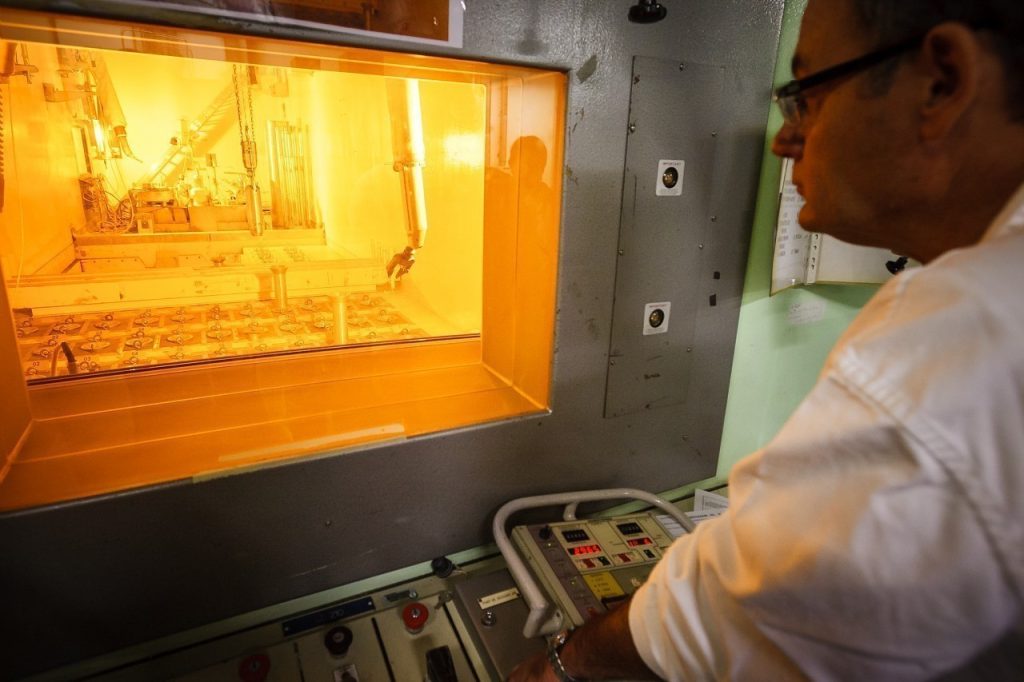
© S.Le Couster / CEA
CEA Research on Dismantling
Dismantling and decontamination projects require diverse expertise and technologies. The CEA manages these projects and relies on industrial contractors for most operations. Some projects use standard techniques adapted to the nuclear environment. However, projects often require the development of specific tools or technologies.
Therefore, to improve safety and reduce the time and costs of dismantling and decontamination projects, the CEA has implemented R&D programs in key areas: Precise assessment of the initial state of the facility; waste characterization; decontamination of structures and soils; management methods and tools for dismantling and decontamination; treatment and conditioning of effluents and waste; working in hostile environments, etc.
Among the technologies developed at the CEA: the Maestro robotic arm, for all operations not allowing direct human intervention, a gamma camera which allows to visualize points of radioactivity on a defined area; and Aspilaser, based on a pulsed laser, and intended for paint stripping.
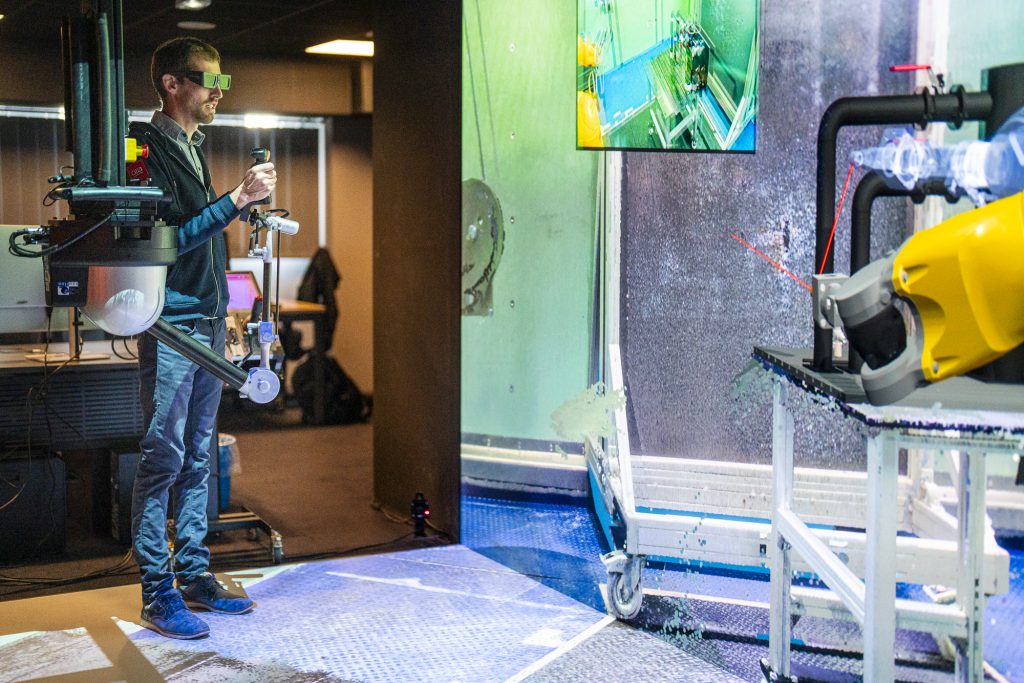
Robot pour le démantèlement nucléaire . © S. Boisset / CEA
Waste Management from Dismantling
The majority of radioactive waste produced by the CEA comes from its dismantling activities. As a nuclear operator, the CEA is responsible for its management. This waste is highly diverse and is managed through approximately 160 technical treatment streams at CEA facilities.
While awaiting a final storage facility for intermediate-level long-lived (IL-LL) and high-level (HL) waste, the CEA is implementing programs for the recovery and conditioning of its old waste, and is continuing the construction or maintenance of its storage facilities in operational condition.